Vibe Coding vs. Agentic Engineering: The Shift from Prompting to Systems
Vibe coding took the industry by storm as a fun, effortless way to prompt software into existence. But as professional codebases began buckling under unmaintainable tech debt, a new consensus emerged: Agentic Engineering. Here is an honest, source-backed look at the trade-offs of both paradigms.
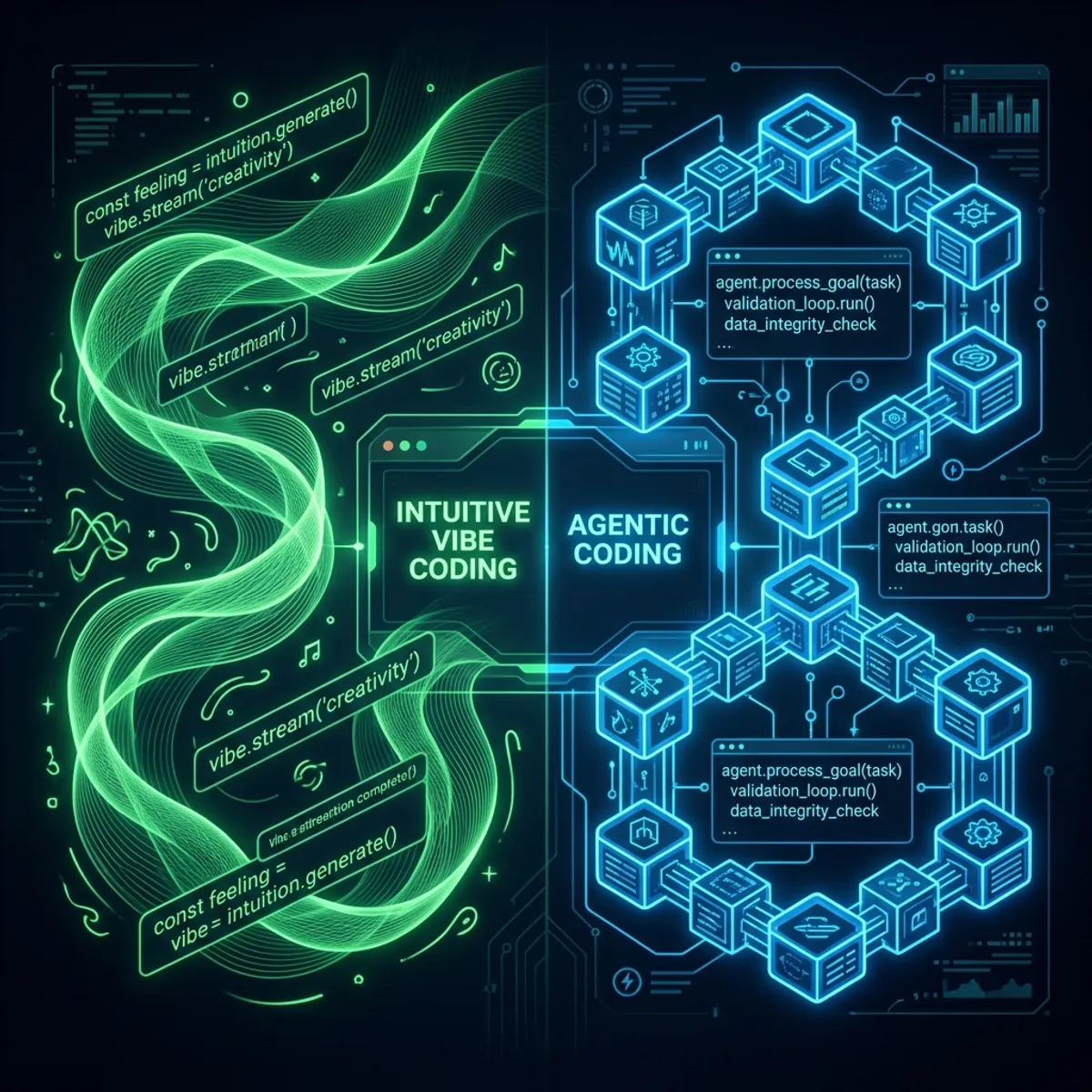
In early 2025, AI researcher Andrej Karpathy coined the term “vibe coding” to describe a new, fast-paced style of software development. Instead of typing out code line-by-line, developers—and increasingly, non-developers—interacted with AI coding assistants (like Cursor, Claude, or ChatGPT) via natural language. You described the “vibe” of what you wanted, hit generate, accepted all edits, and ran the program. If it worked, you moved on.
It felt magical. It democratized software creation, allowing raw ideas to become functional prototypes in minutes.
Yet, by late 2025, a heavy backlash had formed. Tech leaders and professional software developers declared “RIP vibe coding,” warning that prompt-and-pray development was producing unmaintainable, insecure spaghetti codebases. From this friction, a more disciplined paradigm took shape: Agentic Engineering.
Here is an honest, source-backed analysis of vibe coding versus agentic engineering, their core trade-offs, and where software development is heading.
🌊 The Anatomy of Vibe Coding
Vibe coding is characterized by rapid generation and low cognitive overhead. The developer acts as a high-level creative director, guiding the AI through successive prompts while delegating all syntax, logic, and structure to the model.
The Value: Prototyping at the Speed of Thought
As Simon Willison notes, vibe coding is a massive accelerator for experienced developers who want to skip the boilerplate, write quick utilities, or build throwaway proof-of-concepts. For non-programmers, vibe coding is a democratizing superpower. It removes the syntax barrier and lets them build functional software that solves immediate, personal problems.
In vibe coding, the focus is entirely on the immediate output. If the application runs and looks right, the “vibes” are good.
The Problem: The Technical Debt Trap
While vibe coding is excellent for small scripts and visual mockups, it becomes highly toxic in production environments. Critics point out several critical failures:
- Cognitive Disconnection: Because the vibe coder doesn’t write or review the code, they do not understand its structure, security vulnerabilities, or performance bottlenecks.
- The “Friday Afternoon Hand-off”: A common pattern has emerged where non-technical product owners or hobbyists “vibe code” a prototype, hit a brick wall, and hand it to a software engineer to “clean up.” The engineer often finds a brittle, undocumented maze of code that must be completely rewritten from scratch.
- Regression and Fragility: Without unit tests or strict compiler loops, changing one feature in a vibe-coded codebase can silently break three others.
🛠️ The Rise of Agentic Engineering
As the limitations of vibe coding became clear, the industry shifted toward Agentic Engineering (or Agentic Coding).
Unlike vibe coding—which is centered around ad-hoc user prompting—agentic engineering is a structured, systems-oriented approach. It combines autonomous AI agents with traditional software engineering guardrails (like source control, static analysis, unit testing, and structured planning) to build reliable, production-grade applications.
In an agentic workflow, the AI doesn’t just write code; it operates in a closed-loop feedback cycle:
┌────────────────┐ ┌────────────────┐ ┌────────────────┐ │ 1. PLAN FIRST │ ───► │ 2. REFINEMENT │ ───► │ 3. IMPLEMENT │ │ Agent analyzes │ │ User reviews │ │ Targeted, │ │ files & drafts │ │ design and │ │ non-contiguous │ │ execution plan │ │ architecture │ │ code edits │ └────────────────┘ └────────────────┘ └────────────────┘ │ ┌────────────────┐ ┌────────────────┐ │ │ 5. CODE REVIEW │ ◄─── │ 4. TESTING │ ◄─────────────┘ │ Lints, reviews │ │ Runs compiler │ │ & self-heals │ │ and test suite │ └────────────────┘ └────────────────┘- The Plan-First Mandate: The agent is forbidden from writing code immediately. Instead, it must generate a structured execution plan, mapping out affected files, API modifications, and edge cases.
- Human-in-the-Loop Refinement: The engineer reviews and refines the plan before any code changes are made.
- Targeted Implementation: The agent modifies specific code blocks instead of rewriting entire files.
- Automated Testing & Self-Healing: The agent runs test suites and compiler checks. If compile errors or test failures occur, the agent intercepts the stack traces and automatically self-corrects until tests pass.
- Rigorous Review: The final output is checked against project standards, lint rules, and performance guidelines.
📊 Side-by-Side: Vibe vs. Agentic
| Dimension | Vibe Coding | Agentic Engineering |
|---|---|---|
| Primary Philosophy | ”If it runs, ship it." | "Design, implement, test, verify.” |
| Human Role | Consumer of output (Vibe checker) | System architect & supervisor |
| Workflow | Conversational prompting | Multi-step agent loops (Plan-Act-Verify) |
| Verification | Manual click-testing | TDD, Automated unit tests, & compiler checks |
| Code Quality | Often repetitive, unstructured | Adheres to styling guidelines & architecture |
| Ideal Use Case | Personal scripts, UI mockups, prototypes | Production codebases, enterprise services |
| Risk Level | High (hidden bugs, security flaws) | Low (managed via PRs and test suites) |
🧑✈️ The Developer as the Pilot
The transition from vibe coding to agentic engineering changes the definition of what it means to be a software engineer. We are moving away from manual typing and syntax memorization, but we are not moving away from engineering discipline.
Andrej Karpathy highlighted that even when we outsource the labor of coding to AI agents, developers must maintain taste, judgment, and architectural vision. If you don’t know how a clean, scalable system should be structured, you will not be able to guide the agent or catch its subtle, systemic logical errors.
Simon Willison coined the term “Vibe Engineering” to represent a responsible middle ground: using the velocity of AI models to write code, but wrapping that velocity in standard professional practices—using git branches, writing comprehensive test suites, checking logs, and performing rigorous code reviews.
💡 Conclusion: Rigor Wins
Vibe coding is a fun, accessible playground, but it is not a replacement for software engineering. As AI systems become more autonomous, the developers who thrive won’t be those who merely prompt the fastest. They will be the ones who build the best validation systems, enforce strict architectural boundaries, and use agentic workflows to multiply their engineering rigor.
At the end of the day, AI can write the lines of code—but only human engineers can design the system.
Are you vibe coding your personal projects, or have you integrated structured agentic workflows into your day-to-day development? Let me know your thoughts in the comment section below!